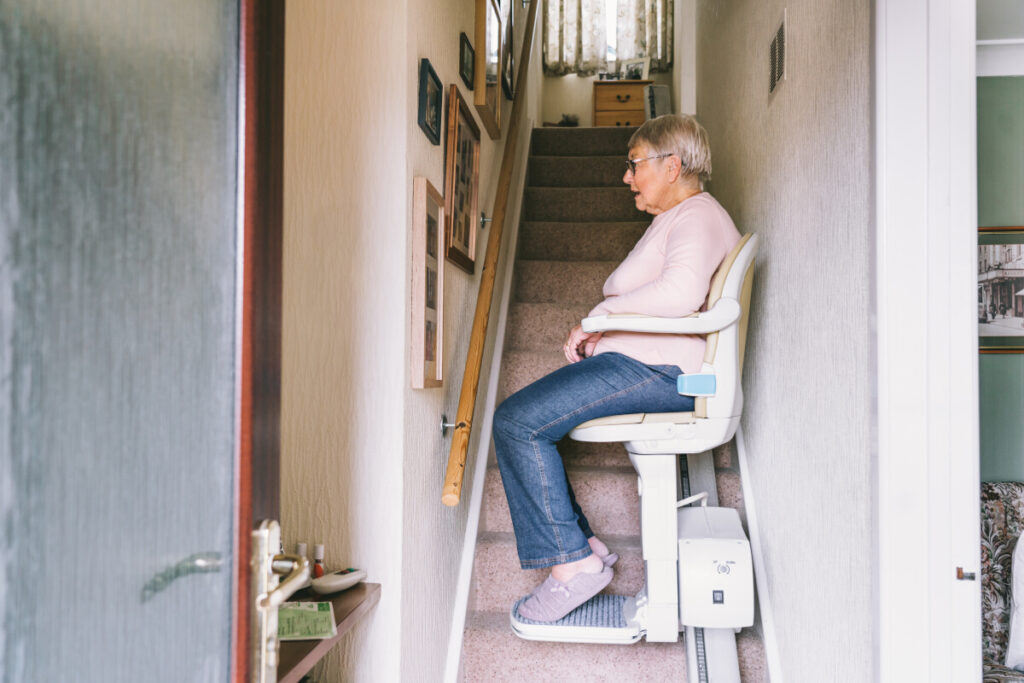
Installing a stairlift in a collective building or in a semi-detached house quickly raises legal questions. A senior from the Grand Est who wishes to hire a professional in the Grand Est to equip their staircase sometimes needs to obtain a vote in a general assembly, inform the property manager, or provide a medical certificate. The right to accessibility, enshrined in several texts, facilitates these procedures today, but the rules remain poorly understood. This guide brings together essential references: average costs, local assistance, specificities of old Alsatian buildings, field testimonials, and comparisons with other accessibility solutions.
Average Prices Observed in the Region
The installation prices for a stairlift in the Grand Est vary according to the complexity of the staircase. For a straight rail installed on a simple flight in rural housing, the indicative range starts at around four thousand euros. For a custom-made curved rail, common in medium-sized towns with old houses, the budget can easily exceed eight thousand euros, including options. These orders of magnitude remain strictly indicative: only a personalized quote, preceded by a technical visit, provides a reliable figure. The motorization, the length of the rail, the number of turns, the comfort of the seat, and safety accessories directly influence the bill. Installation in a co-ownership can also generate additional costs, especially when it is necessary to reinforce fixings on a shared stringer or install a dedicated power supply.
Why the Grand Est is Concerned with Accessibility
The Grand Est has an aging population, particularly in medium-sized towns and rural areas of Alsace, Lorraine, and Champagne-Ardenne. Many seniors live in old houses built on multiple levels, sometimes inhabited for several generations. Home care, supported by public authorities, requires adapting these homes to the gradual loss of autonomy. The stairlift plays a key role: it prevents premature entry into nursing homes, preserves familiar landmarks, and allows continued habitation of the entire dwelling. In rural housing, where local alternatives are lacking and walking to a store can already be an effort, being able to access one’s bedroom or bathroom on the upper floor independently profoundly changes daily quality of life.
Feedback from Seniors in the Grand Est
Testimonials collected from families converge on several points. Seniors first express immediate relief: no longer fearing falls, no longer giving up on the upper floor, no longer depending on a relative to go to bed. Caregivers, for their part, highlight the simplification of daily life and the reduction of constrained trips. Serious installers systematically plan a familiarization session, sometimes repeated several days after installation, to reassure the user. The main regrets, on the other hand, concern the time lost before the decision: many would have liked to equip themselves earlier, without waiting for a fall or hospitalization to trigger urgency. Anticipating the equipment, while the person is still mobile, allows for a calm adaptation and avoids decisions made in family haste.

Regional and Departmental Assistance Available
Several aids can be combined to reduce the remaining costs. The APA from the Departmental Council finances part of the equipment when the loss of autonomy is recognized by the medical-social team. The ANAH, through MaPrimeAdapt’, supports low-income households engaged in adaptation work. A tax credit for accessibility equipment can complement the setup, subject to eligibility conditions. Some pension funds, particularly in Champagne-Ardenne and Alsace, offer specific programs for their members. Municipal CCAS and departmental councils often maintain an updated list of approved installers. Finally, some mutual insurance companies provide a “housing adaptation” package. To benefit from this, it is crucial to submit the files in the correct order, always starting with the ANAH before any contractual commitment. A professional experienced in this type of setup will know how to guide you through the stacking of aids and the preparation of the administrative file.
Specificities of Old Buildings (Alsace, Lorraine, Champagne-Ardenne)
The old buildings in the region have particularities that an experienced installer can identify in one visit: narrow staircases, flights with uneven steps, old wooden stringers, complex fixings on stone or timber-framed structures. In Alsace, half-timbered houses sometimes require a fixing on a load-bearing beam rather than on a step. In Lorraine villages, stone spiral staircases require a particularly elaborate curved rail. For characteristic houses of regional rural housing, it is better to call on a professional in the Grand Est familiar with the constraints of local construction and capable of identifying the best rail configuration. In co-ownership, the legal question also arises: installation in common areas generally requires a vote in the general assembly, while installation in private areas simply requires informing the property manager. The right to accessibility facilitates these procedures today, but legal assistance remains useful to secure the file.
Focus on Medium-Sized Towns in the Grand Est
In medium-sized towns, the demand for equipment is steadily increasing. Reims, Metz, Mulhouse, and Troyes have a senior population living in old bourgeois houses with characteristic staircases. Compared to other accessibility solutions, the stairlift often proves to be the best compromise: an external access ramp does not solve the problem of the upper floor, and a private elevator, much more expensive, requires a dedicated shaft that is rarely available. The stairlift, on the other hand, is fixed directly onto the existing staircase, without heavy masonry work. Its installation remains reversible, which reassures owners concerned about preserving the property’s heritage value. In the co-ownerships of these medium-sized towns, property managers are beginning to integrate these requests into their general assembly agendas.
FAQ — Stairlift
Is a vote from the general assembly required to install a stairlift in a co-ownership?
If the installation concerns common areas, yes: a vote is required according to the rules set by law. Since the ELAN law, accessibility works for people with reduced mobility benefit from a simplified procedure. In private areas, a simple notification to the property manager is usually sufficient, accompanied by a medical certificate if necessary.
Is a stairlift preferable to a private elevator?
In most old houses, yes. A private elevator requires a dedicated shaft, heavy work, and a much higher budget. The stairlift is installed directly on the existing flight, without modifying the structure. It remains reversible and preserves the property’s heritage value, which reassures owners attached to their character home.
Can APA, ANAH, and tax credit be combined?
Yes, within the limit of the actual remaining costs borne by the household. The ANAH intervenes first, then the APA complements according to the aid plan, and the tax credit applies to the remaining amount after deducting other aids. A France Rénov’ advisor or a social service can verify your eligibility and organize the procedures.