The CTS regulation (Tents, Canopies, and Structures) encompasses the safety rules defined by the decree of January 23, 1985, which complements the general regulations for ERP (Establishments open to the public). The protection of participants against fire, panic, and collapse risks is its main objective. The decree of February 18, 2010, introduced some modifications to better protect the public. The CTS regulation applies to temporary and mobile installations. It specifies the quality standards and emphasizes the obligations of owners and organizers.
What does the CTS regulation apply to?
The CTS regulation applies to tents, canopies, and structures intended to accommodate the public (ERP) when their area exceeds 16m2 or they can host at least 20 people. The equipment has a flexible cover (canvas, tarp), and they are fully enclosed or partially enclosed.
The regulation concerns all models, whether installed on public or private land. The obligations vary according to the area and capacity.
An authorized organization like Apex Controle checks the compliance of each unit before its first installation.
Main points of the CTS regulation
Quality standards
The sturdiness of the structure protects the public from the elements. The frameworks can withstand gusts of 100km/h and heavy snowfall, which is 15 kg/m2.
Fires pose a significant risk. Manufacturers must use a material of minimum class M2 for tarps and flexible walls. Their low flammability limits the spread of potential flames.
The capacity varies according to the dimensions. The number of exits depends on the maximum occupancy. The location and width facilitate entry and exit.
Operation
An accredited organization verifies that the CTS comply with technical standards at least one month before the first use. It issues a favorable opinion for obtaining the certificate of compliance from the Prefect of the department. The state representative issues the valuable document after a positive opinion from the departmental advisory commission on safety and accessibility. The competent authority is the police prefect for Paris.
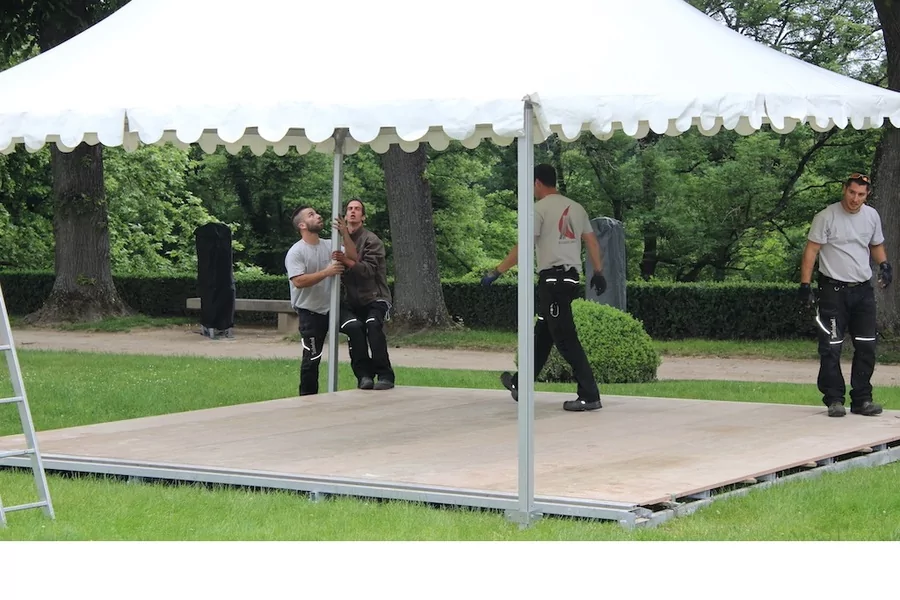
The organizer entrusts the installation to specialists. They complete the certificate of proper assembly before welcoming the public.
The safety register is an essential document. It includes three main sections: administrative and technical documents, operation and monitoring, and periodic checks and verifications.
Each structure larger than 50m2 has its own register and a registration number. In addition to the department code, the number includes the year of issuance of the certificate of compliance to facilitate inspections.
An authorized control office checks the CTS every two years.
The extended installation (longer than 6 months) is subject to specific provisions. The issuance of the safety register requires a visit from the members of the safety commission. Furthermore, the CTS must be located more than 4 meters from another structure.
The CTS control office
The Ministry of the Interior publishes the list of authorized control offices. The authorization lasts for 5 years and must be renewed after this period. Their teams must have the required skills to successfully carry out verification and control missions.